WhiteBox or getcracked.io?
Many have asked us how WhiteBox differs from getcracked.io, so here's the honest version.

getcracked.io is a quant question bank, and it's a reasonable one if that's what you want. It's often marketed as the "LeetCode for quant," and that's an accurate description of what it does, a large pile of recently-asked interview questions you can grind through. If your goal is to drill the specific problems firms are asking this cycle, it's built for exactly that, and I won't pretend otherwise.
The difference is what each platform is optimizing for, and it comes down to one choice: do you want to remember questions, or learn to derive answers? getcracked.io is organized around recall. The value proposition is seeing the question before the interviewer does, which works right up until you get one you haven't seen. WhiteBox is organized around the opposite, remembering the principles that let you reason out a solution from scratch. That's the whole reason the platform is split the way it is: synthesis through the core catalog, intuition through the competitive-programming-style roadmap, and association across techniques through the domain section. The aim is to not need to have seen your interview problem before.
That shows up in the coding problems. Analogous to WhiteBox's core catalog, getcracked.io has some implementation questions, but the useful ones tend to be buried deeply under filler (often standard DSA problems reworded to feel "quant-flavored"). But that's fine for what it is. A recently-asked-question bank's job is to show you what companies are asking so you can prepare those specific problems, not to build the synthesis foundation that lets you handle whatever shows up, which costs more effort up front and is a different goal entirely. Their implementation problems are trying to be representative, and judged as that, the filler is just the cost of breadth.
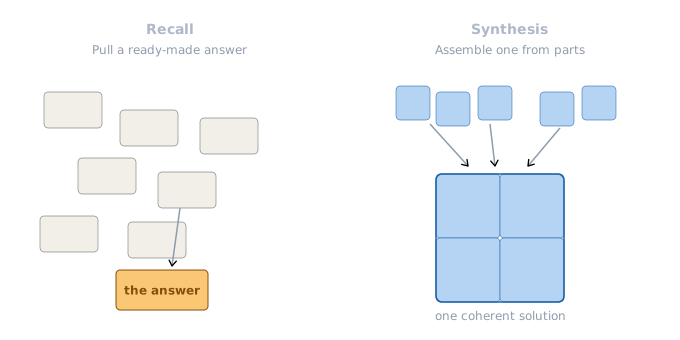
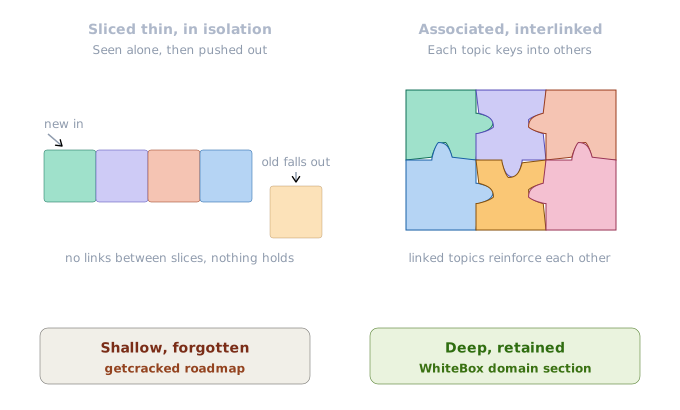
The closer comparison is getcracked.io's roadmap against WhiteBox's domain section, since both are the "learn the material" half. Their roadmap, despite covering a lot of material, is sliced so finely with book subsections cited across dozens upon dozens of sub-submodules that you never get to put two approaches next to each other. Comparing methods and feeling out their tradeoffs is most of where real understanding and depth comes from, and that granularity removes it. It also kills retention: concepts stick when you associate them with each other, and you can't associate things you only ever see in isolation.
Their "we only cite the subsections you actually need, so you pay for the time saved" pitch sounds enticing, but follow the citations across all those sub-submodules and you've been routed through most of the book anyway, just without the connective tissue that would have made it cohere. You did the reading either way. You just didn't get to see how any of it fit together. One caveat on these last two sections: everybody learns in different ways. Some people may find getcracked.io's granular roadmap easier to digest, and getcracked.io may have left out the comparisons on purpose. The question here is how the two sites differ and why we built ours this way, not which one is better.
Last, and certainly the most tangible difference: getcracked.io's entire platform, including its coding & learning, sits behind a paid subscription. WhiteBox's content is completely free. Need I say more?